The Colour-First Mistake in Meadow Plant Identification
Meadow plant identification gets clearer when you compare flower structure, leaf arrangement, and habitat, so you can narrow choices without disturbing plants.
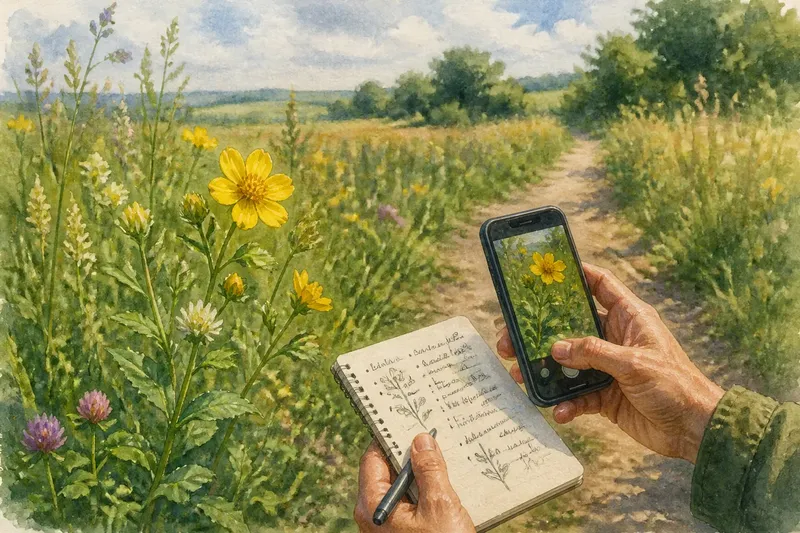
A yellow bloom beside a meadow path catches your eye, and your phone offers a name before you have taken a second look. Meadow plant identification is more dependable when you compare the flower’s structure with the plant’s leaves and growing form, rather than choosing by color alone.
Color can help narrow the possibilities, but it rarely separates lookalikes on its own. A useful record focuses on visible features that can be compared with a regional field guide or an identification app—without picking or moving the plant.
Why does flower color mislead?
Many unrelated meadow plants share broad colors. A cluster of tiny flowers may look like one bloom from the path, while a single large flower can make a similar splash. Sunlight, shade, and a bloom’s stage can also change how its color appears.
Instead of asking only “What color is it?”, notice how the flowers are arranged. Are they grouped in a head, set along a spike, gathered in a loose cluster, or held singly at a stem tip? This shape is often more useful for comparing candidates.
Which features help narrow the possibilities?
Start with details you can see without touching the plant. Look at several leaves and more than one part of the stem, since a single view may hide the arrangement. Plain descriptions are enough: “paired leaves” or “small flowers in a tight head” is more useful than a species name you have not checked.
- Flower arrangement: Observe whether blooms are single, clustered, in a head, or arranged along a spike. If the arrangement is clear, compare it with candidate descriptions; if it is obscured, take a wider photo or leave it unrecorded rather than guessing.
- Leaf attachment: Check whether leaves appear in pairs, alternate along the stem, or gather near the ground. If the pattern is visible at several points, note it; if it is unclear, record the uncertainty and avoid using it to rule candidates in or out.
- Leaf shape and edge: Look for narrow or rounded leaves, divided or undivided blades, and smooth or toothed edges. If these details are visible, compare them with a guide; if not, photograph the leaves from a safer viewing angle or set that clue aside.
- Stem and growth form: Observe whether stems branch, stand upright, or spread low across the ground, and whether the surface looks smooth or hairy. If the form is clear, use it as another comparison; if neighboring plants hide it, do not infer the missing shape.
- Growing place: Note whether the plant stands in open sun, a damp hollow, or among taller vegetation. If the setting matches a candidate’s habitat description, treat it as supporting context; if it does not, reconsider that candidate rather than treating habitat as proof.
- Photograph coverage: Check whether your pictures show both the flower and leaves with the stem, not just a close-up. If the plant’s form is visible, compare the images later; if it is cropped out, take a wider picture from the path or rely on written observations.
A phone camera can help capture details without disturbing the plant. Take one close view of the flower and another showing leaves and stem together. A wider image can preserve the surrounding setting, but avoid stepping into sensitive growth to get it.
How can you compare candidates without a week-long routine?
Use one careful visit to gather the most relevant clues, then check them against a local field guide, a meadow plant book from the library, or an identification app. A regional guide can help because its candidate list is more likely to reflect plants found in your area. Treat app suggestions as possibilities, not settled names.
Imagine you see a purple flower beside a damp trail. Your notes say its blooms form a loose cluster, but the leaves are hidden behind taller grass; an app suggests two plants, one with paired leaves and one with alternating leaves. Compare the visible cluster with both guide descriptions, then take a wider photograph from the path if the leaves come into view. If the attachment pattern remains hidden, the result is a short list rather than a confident species name—a useful tradeoff that keeps the record honest.
For each candidate, ask whether several separate features fit: flower arrangement, leaf attachment, and overall growth form. If one visible feature conflicts with the description, set that candidate aside or look for another view. Do not make color compensate for a mismatch elsewhere.
What if a useful clue is hard to see?
How can I tell whether leaves are opposite or alternate?
Look at the points where leaves join the stem. Opposite leaves appear as a pair at one level; alternate leaves appear one at a time at successive levels. If branches or crowded growth obscure the pattern, record that limitation instead of assigning a pattern from memory.
What should I do if the plant is no longer flowering?
Use any earlier photographs and notes, and record what the plant looks like now. If the remaining features do not distinguish likely candidates, keep the identification broad until another clear view is available.
Can an identification app settle the name?
An app can suggest candidates to compare, but a photo dominated by color may lead to a poor match. Check its suggestions against visible leaves, flower arrangement, and growth form; if those clues do not fit, do not adopt the first result.
Should I pick a flower to inspect it?
Usually, a different viewing angle or a phone camera is enough to record what is visible. Leave the plant in place, especially where site rules restrict picking or meadow growth is sparse; mark hidden details as unknown rather than damaging the plant.
How should you record an uncertain name?
Write down the date, a location description, the visible flower arrangement, leaf details, and anything that could not be seen. Keep observations separate from interpretations: “leaves appear paired” is an observation, while “possibly this species” is a tentative identification.
For meadow plant identification, a broad label can be more useful than a precise name that the visible clues cannot support. If you return and see a detail that changes the comparison, update the record while keeping the original note. The color may have caught your attention, but the plant’s structure is what gives your next identification a better footing.