From Hayfields to Wildflower Meadows: A Changing Landscape
Hayfield history can clarify what a wildflower meadow means. Learn to describe grassland by its use, management, and documented past without overstating its history.
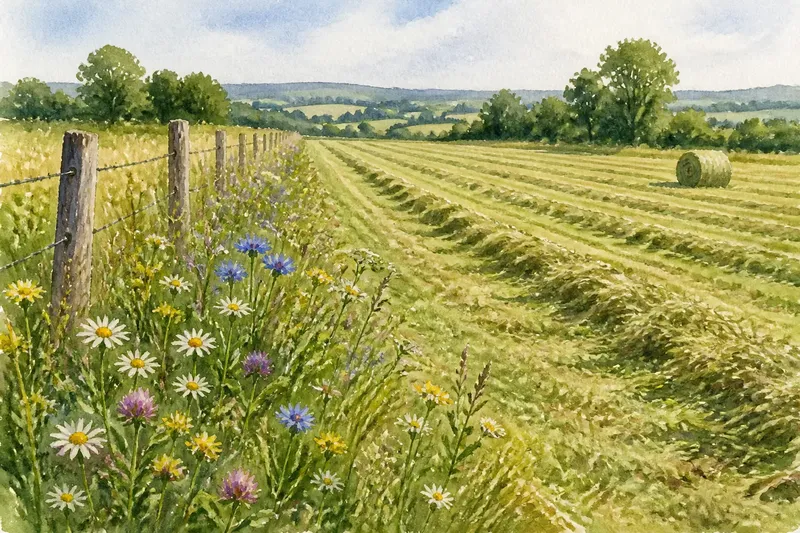
You pause beside a field where a tractor has left neat rows of cut grass, while flowers remain along the fence. Is it a hayfield or a wildflower meadow? Hayfield history can help explain why both names may fit, and why a field’s present appearance alone cannot settle the question.
Why can one field have two names?
“Meadow” can refer to grassland, a working field, or a flower-rich habitat. “Hayfield” points more specifically to land used to grow and cut hay. A grassland can serve that practical purpose and still provide habitat for plants and pollinators.
Appearance is only one clue. Flowers do not tell you whether a field is cut for fodder, grazed, mown for access, or managed with wildlife in mind. A recently cut field may still be valuable habitat, while a flowery field may have been planted recently. The right description depends on what you need to convey.
How did hayfield history shape the name?
In many places, grasslands were managed as working land, including fields cut for hay to feed livestock. Cutting, grazing, local conditions, and available farm practices all helped shape what grew there. In that context, “meadow” could refer to grassland used for hay rather than a site set aside primarily for wildflowers.
The history varies by region and by field, so a broad account cannot explain every local name. In some conservation and gardening contexts, “wildflower meadow” is used for grassland valued for its flowers or habitat, or for a planting intended to create those qualities. An established grassland and a newly created planting may look similar at a glance, but they have different histories.
Names also set expectations. A visitor may picture a sweep of flowers and be surprised by abundant grasses or a recently cut surface. A land manager may choose “hay meadow” to make the field’s working use clear. Neither label tells the whole story on its own.
What does a field’s management tell you?
Management terms describe actions, not necessarily the full ecological value of a place. Cutting for hay, grazing, mowing paths, and allowing vegetation to stand are different practices. A sign or description is more informative when it names the relevant practice rather than treating “managed” and “wild” as opposites.
Clues such as cut rows, fencing, livestock, or maintained paths can suggest what is happening, but they do not prove a field’s past or purpose. For context, look for current information from the landholder or site staff. Local records may help with history; a single visit is better evidence of what is visible at that moment.
How can you describe a meadow without guessing?
Start with the habitat and current management you can support. If the site’s past is uncertain, use a neutral term such as “grassland” and say what is known about its current care. For example, “grassland with flowering edges, mown through the center” describes a visible pattern without claiming an old hayfield history.
Say a community group is preparing a sign for a field with a mown center and flowering margins, but has no records of earlier use. The group checks with the site caretaker, who confirms that the center is mown for access, but cannot confirm whether the field was ever cut for hay. The sign can then say “grassland with flowering margins, maintained by mowing for access.” That wording identifies the observed habitat and known practice while leaving the unverified history unstated.
- Check for cut rows or bales: If you confirm hay is being collected, describe the field as used for hay; if not, call it mown grassland and avoid inferring a hay crop.
- Check for livestock and active grazing: If animals are grazing the field, mention grazing; if animals are absent or the evidence is unclear, do not describe current grazing as confirmed.
- Check whether mowing maintains a path or open area: If the site contact confirms that purpose, name it; if the purpose is unknown, describe the mown area without assigning a reason.
- Check whether the planting is documented as recent: If records confirm a new planting, call it a created wildflower meadow or planting; if its age is unknown, use “grassland with flowering plants.”
- Check for a land-management notice or current site information: If it names a practice, use that information with its scope; if no current information is available, state that management is unclear.
- Check whether a historical claim has local support: If a reliable local record or knowledgeable site contact supports it, include the history; if not, leave the historical label out.
Which meadow terms answer common questions?
Is every meadow a hayfield?
No. “Meadow” is used for grassland in a broad sense, while “hayfield” describes land used to grow and cut hay. If you know only that a place is grassy, “grassland” avoids implying a use you have not confirmed.
Does “wildflower meadow” establish that the plants are native?
No. The phrase alone does not identify the origin of the plants or the history of the site. If origin matters, rely on a trustworthy planting record or a qualified identification rather than the label.
Can a mown field still be a meadow?
Yes. Mowing can be part of a field’s use or care, and a cut surface does not tell you everything about its habitat. Name the mowing alongside the grassland when that distinction matters.
What term fits when a site’s past is unknown?
“Grassland” is a neutral starting point. Add a confirmed detail, such as “with flowering margins” or “mown for access,” and leave older labels out until there is evidence for them.
How does wording keep a field’s history honest?
Specific language lets a working field and its habitat value belong in the same description. It also separates what someone can see today from what records or local knowledge say about the past. When writing about hayfield history, name the current use when it is known, describe visible features plainly, and keep uncertain origins open. That gives visitors a more useful account than a single picturesque label.